Celebrity advocacy is easy to announce and hard to measure. An ambassadorship, a donation or a photograph in a refugee camp tells us that somebody showed up once. It tells us little about what happened afterwards.
This companion to The Light Turned Outward looks at what came after. The people collected here are not included because they were photographed beside a cause, took an honorary title or appeared in a campaign. They are included because they went back, learned the subject, gave time or money, built something that could carry on, or kept directing public attention beyond themselves.
None of this makes the people here beyond criticism. Years of involvement do not show that the work helped, and an organisation’s account of its own reach is not independent evidence of impact. There is a further question: who kept their voice? Celebrity advocacy can amplify people who are rarely heard, but it can also put the famous advocate at the centre and turn the people being spoken for into scenery. Ilan Kapoor argues that this is often how celebrity humanitarianism works: the spectacle favours visible suffering and famous intermediaries, and pushes structural causes and the voices of affected communities out of view.
Each entry below records what a person did and says what that record does not show.
Audrey Hepburn Children and humanitarian relief
The connection: Hepburn’s tie to UNICEF reached back to her own childhood. She said she was among those who received food and medical relief after the Second World War, and she spoke of a lasting gratitude and trust in the organisation.
What followed: She became a UNICEF Goodwill Ambassador in 1988 and travelled widely for it. Her missions included Ethiopia, Turkey, Venezuela, Ecuador, Guatemala, Honduras, El Salvador, Bangladesh, Thailand, Viet Nam, Sudan and Somalia. She kept working in 1992 while ill with cancer.
Public advocacy: She testified before the US Congress, took part in the World Summit for Children, launched UNICEF’s State of the World’s Children reports and gave speeches promoting children’s rights and UNICEF’s work.
Duration: About five years as an official UNICEF ambassador, ending with her death in January 1993.
What this doesn’t show: Her persistence is well documented. What her fame added is harder to separate from the work of UNICEF itself and of the people who ran its programmes on the ground.
Angelina Jolie Refugees and forced displacement
The connection: Jolie became interested in refugees while filming in Cambodia in 2000, and then approached UNHCR to learn more.
What followed: She was a UNHCR Goodwill Ambassador from 2001 to 2012 and Special Envoy from 2012 to 2022. UNHCR records more than sixty field missions over more than twenty years. In September 2001, a month after her appointment, she pledged $1 million to UNHCR’s Afghanistan emergency appeal. Kapoor, who is sharply critical of celebrity humanitarianism, acknowledges the personal time and money she devoted to the work, as well as her effort on behalf of UNHCR. He still argues that this does not settle the questions of branding, power and structural change.
Public advocacy: In a 2019 essay for TIME she argued that the border crisis did not force a choice between security and humanity, and that displacement would keep growing unless its causes were addressed at the source, from war and economic desperation to corruption and climate change. She defended international asylum standards and backed UNHCR’s call for a summit of governments in the Americas.
Duration: More than twenty years in formal UNHCR roles.
What this doesn’t show: Her record answers whether she came back. It does not show whether her advocacy changed the causes of displacement. Kapoor cites her 2006 CNN programme on Africa as an example of African voices going unheard.
Vanessa Redgrave Refugees, children and human rights
What followed: Redgrave became a UNICEF Goodwill Ambassador in 1995 and has travelled with UNICEF to Albania, Brazil, Israel, North Macedonia, the State of Palestine and, in 2018, Lebanon.
Public advocacy: She took the cause into her own filmmaking. In 2017 she directed and co-produced Sea Sorrow, a documentary about the refugee crisis in Syria and Europe.
Duration: More than three decades with UNICEF by 2026.
What this doesn’t show: Redgrave has campaigned politically for decades, including for Palestinian causes, and some of that activism has drawn controversy. Her entry rests on her UNICEF record and does not endorse her wider politics.
Ted Danson Oceans
The connection: Danson has said that his ocean work began when he took his young daughters to swim at a Santa Monica beach and found a sign saying the water was polluted.
What followed: In 1987 he helped establish the American Oceans Campaign, which worked on ocean protection before becoming part of Oceana. He has served on Oceana’s board.
Public advocacy: In 2002 he testified before the US Commission on Ocean Policy, urging it to make ocean conservation a cornerstone of federal policy. In 2019 he testified to a House subcommittee on plastic pollution.
Duration: Nearly four decades of ocean advocacy.
What this doesn’t show: The concern became an institution rather than a one-off campaign. Judging that organisation’s effect on the oceans takes evidence beyond his own staying power.
Yao Ming Wildlife conservation
The connection: Yao became a WildAid ambassador in 2006 after signing a pledge to give up shark-fin soup.
What followed: He appeared in public-service announcements, billboards and television campaigns against shark fin, ivory and rhino horn. His shark-fin campaign asked consumers to stop eating the soup. In April 2013 he launched the Say No to Ivory and Say No to Rhino Horn campaigns with WildAid, the African Wildlife Foundation and Save the Elephants. He travelled to Africa to see poaching for himself and starred in WildAid’s documentary The End of the Wild.
Public advocacy: As a delegate to the Chinese People’s Political Consultative Conference, a national political advisory body, he delivered a petition in March 2014 asking the government to ban ivory sales.
Duration: About twenty years of conservation advocacy by 2026, starting with his WildAid ambassadorship in 2006.
What this doesn’t show: WildAid says his messages reached hundreds of millions of people and that he was instrumental in the campaign behind China’s ivory ban, which took effect at the end of 2017. Those claims come largely from the campaigning organisation. What can safely be said is that he gave years of visibility and political pressure to the cause. How much of the change in behaviour or policy was his cannot be separated from government action, wider media coverage and other campaigners.
Elton John HIV/AIDS
The connection: John’s friendship with Ryan White, an American teenager who contracted HIV through contaminated blood products, was one of the things that pushed him towards sustained AIDS activism.
What followed: He founded the Elton John AIDS Foundation in 1992. Its work has included prevention, testing and treatment, alongside efforts to reduce stigma and discrimination.
Public advocacy: John testified before US Senate committees in 2002, 2015 and 2023, asking for funding for the global AIDS response and, in 2023, urging the Senate Foreign Relations Committee to renew PEPFAR, the US government’s global HIV programme.
Duration: More than three decades.
What this doesn’t show: The foundation reports raising more than $660 million and supporting more than 3,200 projects in 108 countries. Those are its own figures. They show scale, not outcomes, and they cannot say whether its focus on stigma and access has changed who gets care.
Rihanna Health, climate resilience and community programmes
What followed: Rihanna founded the Clara Lionel Foundation in 2012. It began with a grant to Queen Elizabeth Hospital in Barbados and now funds health access, climate resilience, women-led businesses, arts and culture, and young people in the Caribbean, East Africa and the US South.
Public advocacy: Since 2016 she has been Global Ambassador for the Global Partnership for Education. In 2018 she attended its financing conference in Dakar, publicly urged world leaders to pledge, and wrote a Guardian op-ed asking governments to fund education. The conference saw $2.3 billion pledged.
Duration: Fourteen years by 2026.
What this doesn’t show: CLF reports giving more than $100 million in grants since 2012 and says its projects and partners are community-led. Both are the foundation’s own statements, and no one can say what share of the Dakar pledges followed from her advocacy. A better test is where decisions are made: whether funding and control rest with local organisations or with the celebrity founder.
Matt Damon Water and sanitation
The connection: Damon has said that his water work began with a 2006 trip to rural Zambia.
What followed: He founded H2O Africa in 2006. In 2009 it joined forces with Gary White’s WaterPartners to form Water.org.
Public advocacy: Damon and White wrote The Worth of Water (2022), an account of their work.
Duration: About twenty years.
What this doesn’t show: Water.org reports that it has reached more than 92 million people. That is its own figure. Damon’s case also shows the gap between founding an organisation and doing its technical work, which White, a water and sanitation engineer, Water.org’s staff, its partners and the communities themselves carry out.
Sean Penn Disaster response
The connection: Penn went to Haiti after the January 2010 earthquake, planning a stay of roughly two weeks. It did not end with the emergency.
What followed: His effort became J/P Haitian Relief Organization and, later, CORE. CORE says it stayed in Haiti after the emergency and that its work there continues with Haitian staff.
Duration: Sixteen years since the 2010 earthquake.
What this doesn’t show: Disaster response raises the question this list keeps returning to: does an outside organisation build local capacity and hand over control, or become a permanent go-between? Sixteen years of staying does not answer it.
How to read this record
The entries separate activity from impact. Years of involvement, field visits, money pledged or given, testimony and institutions can usually be documented. Whether any of it solved the problem is much harder to know.
Kapoor’s critique is a useful check on admiring people for how long they stayed. He grants that famous advocates may know their subjects, give resources and do real work, and he still argues that celebrity humanitarianism can reinforce existing economic and political power. He also argues that when celebrities speak for communities, those communities can come to look passive in the stories told about them.
Read across these entries with six questions in mind. Did they return? Did they learn? Did they put resources behind it? Did they build something that could continue without them? Did they turn their attention, and the public’s, towards something beyond themselves? And where it can be known, did the people most affected keep their voice, their expertise and their say in the work?
Sources and further reading
- UNICEF, Audrey Hepburn: Goodwill Ambassador from 1988 to 1993Her missions, advocacy and her own account of receiving UNICEF aid.
- UNHCR, Former Special Envoy Angelina JolieHer roles from 2001 to 2022 and more than sixty field missions.
- UNHCR, Angelina Jolie responds to UNHCR emergency appeal (27 September 2001)The announcement of her $1 million commitment.
- UNHCR Korea, With You, Summer 2017: UNHCR Goodwill Ambassador Series 2, Angelina Jolie. How she came to UNHCR after filming in Cambodia.
- TIME, Angelina Jolie, The Crisis We Face at the Border Does Not Require Us to Choose Between Security and Humanity (31 July 2019)Her argument on asylum and the causes of displacement.
- UNICEF, Vanessa Redgrave: Goodwill Ambassador since 1995Her UNICEF travel and Sea Sorrow.
- Oceana, Ted DansonHow his ocean work began and the history of the American Oceans Campaign.
- Oceana, Ted Danson Testifies Before U.S. Commission on Ocean Policy (2002)His 2002 testimony.
- Ted Danson, written testimony to the US House Committee on Natural Resources (29 October 2019)His testimony on plastic pollution.
- WildAid, Yao MingHis ambassadorship and campaigns.
- WildAid, Yao Ming Urges China to Say No To Ivory and Rhino Horn With New Film (August 2014)The 2013 campaign, the 2014 petition and The End of the Wild.
- Elton John AIDS Foundation, Our HistoryThe foundation’s founding and reported totals.
- US Senate HELP Committee, Capacity to Care in a World Living with AIDS (11 April 2002)Elton John’s 2002 testimony.
- US Senate Appropriations Committee, Global Health Programs hearing (6 May 2015)Elton John’s 2015 testimony.
- US Senate Foreign Relations Committee, PEPFAR at 20 (19 April 2023)Elton John’s testimony urging continued support for the programme.
- Clara Lionel FoundationIts founding, grantmaking and organisational claims.
- The Guardian, Rihanna, Growing up in Barbados, school was a grind. But I was lucky (18 September 2018)Her public call for governments to fund education.
- Water.org, Matt DamonH2O Africa and the creation of Water.org.
- Gary White and Matt Damon, The Worth of Water (Portfolio, 2022)Publisher information for the book.
- CORE, Our StoryThe 2010 Haiti response and continued work with Haitian staff.
- Ilan Kapoor, Celebrity Humanitarianism: The Ideology of Global Charity (Routledge, 2013)Critical analysis of celebrity humanitarianism, including representation, structural causes and celebrity power.
Image note
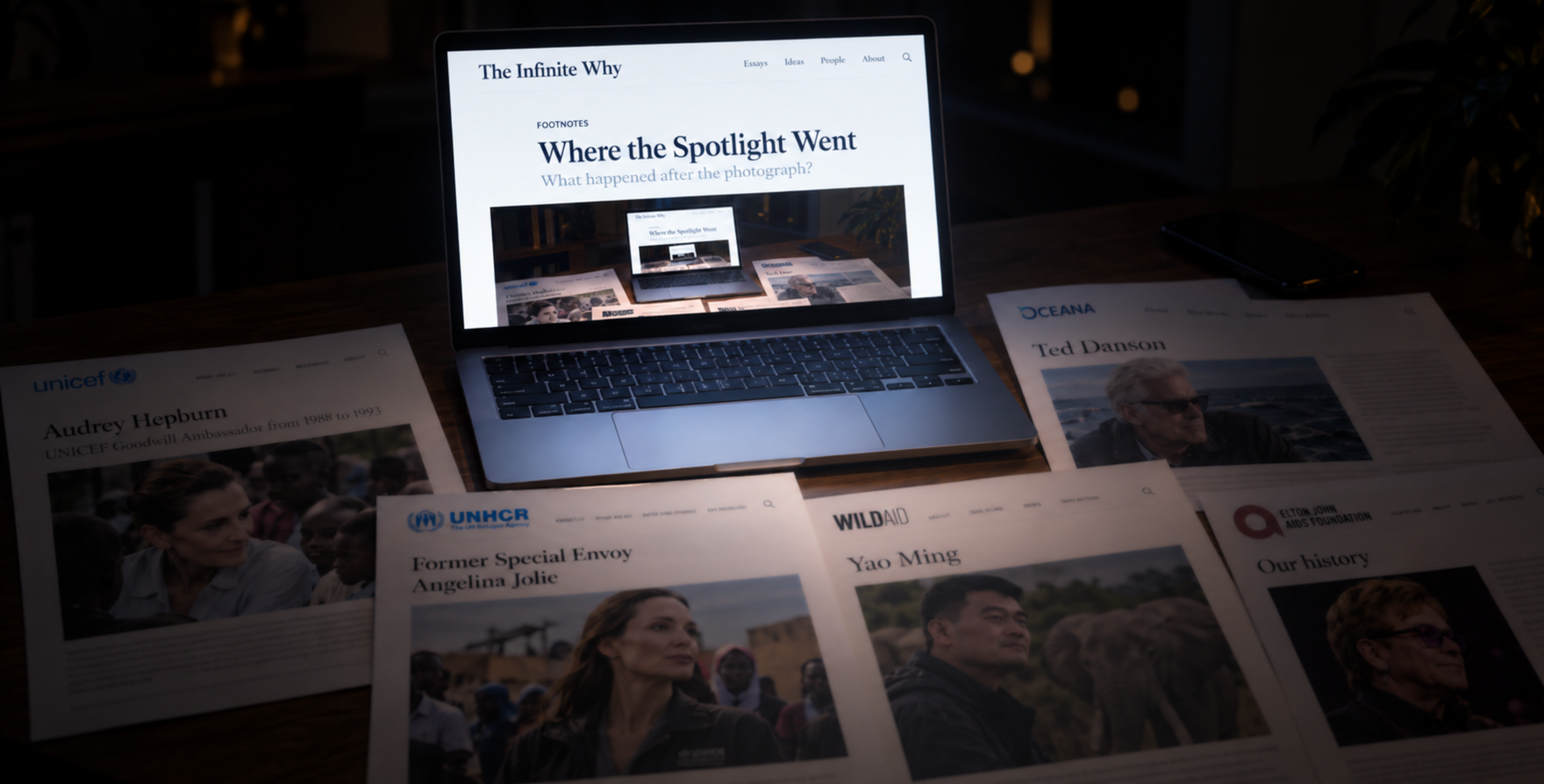
The hero image is an illustrative research-table composite created for The Infinite Why. It is not an archival photograph or a reproduction of the cited source pages.