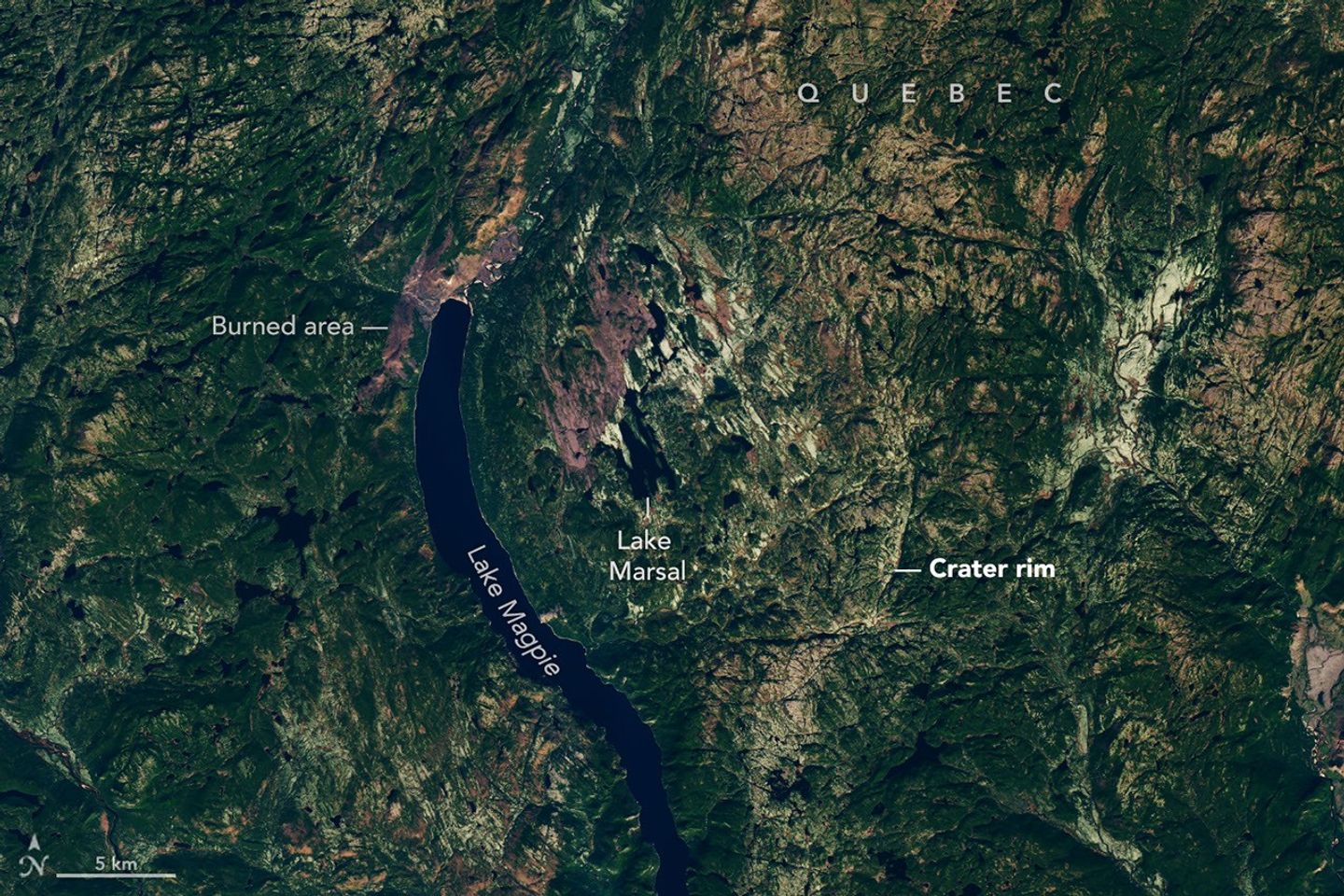
In 2024, Joël Lapointe was planning a camping trip to Quebec’s remote Côte-Nord region when something on a satellite map caught his attention. Near Lake Marsal, the landscape appeared to curve into a circle. Lapointe, an amateur astronomer, wondered whether the depression might be the remains of a meteorite impact. He contacted specialists in Europe and North America.
The shape was subtle. In a Landsat image captured the following year, the circular depression is visible with Lake Marsal near its centre. Earlier geological mapping had offered an explanation for the fractured rocks in the area: a diatreme, a geological structure associated with explosive volcanic activity. A circle on a map was hardly enough to overturn that interpretation.
But Lapointe’s questions travelled. French researchers identified the Lake Marsal area as a possible impact structure at a 2024 meeting of the Meteoritical Society. Their work eventually drew the attention of Gordon Osinski, a planetary geologist at Western University in Canada. Osinski was sceptical at first, but the possibility intrigued him enough to join an expedition organised by CEREGE, a research centre based in France.
In October 2025, the researchers arrived by floatplane. The aircraft could not approach the shore closely enough for them to disembark on dry ground, so they waded fifty metres through the lake carrying their equipment. Beyond the water lay swamp, difficult terrain and what Osinski described as “deep, twisty, gnarly vegetation.” He had conducted fieldwork on six continents, yet counted this among the most challenging environments he had encountered.
By the second day, the team had found shatter cones in numerous rock outcrops. These distinctive fracture patterns form when rock is subjected to the extreme shock pressures of an impact. Osinski regards them as the only field evidence of an impact that is both unequivocal and visible to the naked eye. What had appeared from orbit as a faint circle now had evidence beneath it.
The structure is about 25 kilometres across, with a central uplift and cliffs displaying columnar jointing. Osinski said that an impact of comparable magnitude in present-day Quebec could destroy major cities and have consequences for the global climate. Rock samples suggest that the event likely occurred around 390 million years ago, long before the first dinosaurs appeared.
Three hundred and ninety million years. A collision that left a structure 25 kilometres across, its traces surviving in rock across a span of time that reaches far beyond the history of our own species.
Only about 200 impact structures have been confirmed on Earth. Geologists suspect that hundreds more remain unidentified. The structure that the research team calls Uhackatik is the largest impact crater identified since the discovery of the 31-kilometre Hiawatha structure in 2018.
The name Uhackatik was adopted following consultations with the Innu Council of Ekuanitshit. NASA’s account does not say what the name means or how those discussions went, and neither do the other sources used here.
Lapointe encourages others to pay attention to observations and intuitions even when they fall outside their own fields of expertise.
When NASA published its account in September 2026, the researchers regarded the impact origin as essentially confirmed. Formal recognition by the Meteoritical Society’s committee was still expected.
The circle remains visible in satellite imagery, with Lake Marsal near its centre. Among the hundreds of impact structures geologists suspect remain unidentified, there may be another outline that someone has already wondered about for a moment before closing the map.
Explore related topics: Science · History · Proof of Hope
Sources and further reading
- Adam Voiland, NASA Earth Observatory, “An Accidental Impact Crater Discovery” (15 September 2026)Principal reporting; Lapointe’s remark is quoted by NASA from Radio-Canada. Updated 25 September 2026.
- Gattacceca, J., et al., “Uhackatik: A New 25-km Diameter ~390 Ma Impact Structure in Quebec, Canada” (2026)88th Annual Meeting of the Meteoritical Society. Cited in NASA’s references; abstract not independently examined.
- Rochette, P., “Lake Marsal: A Large Impact Structure Candidate in Quebec (Canada)” (2024)86th Annual Meeting of the Meteoritical Society. Cited in NASA’s references; abstract not independently examined.
- Belgian Platform on Earth Observation, “A Giant Impact Crater Hiding in Plain Sight” (16 September 2026)Secondary account based on NASA Earth Observatory.
Research note (14 October 2026): Geological estimates and recognition status follow NASA Earth Observatory’s September account. No announcement of formal recognition by the Meteoritical Society’s committee had been found as of 14 October 2026; the committee's own records were not independently confirmed.