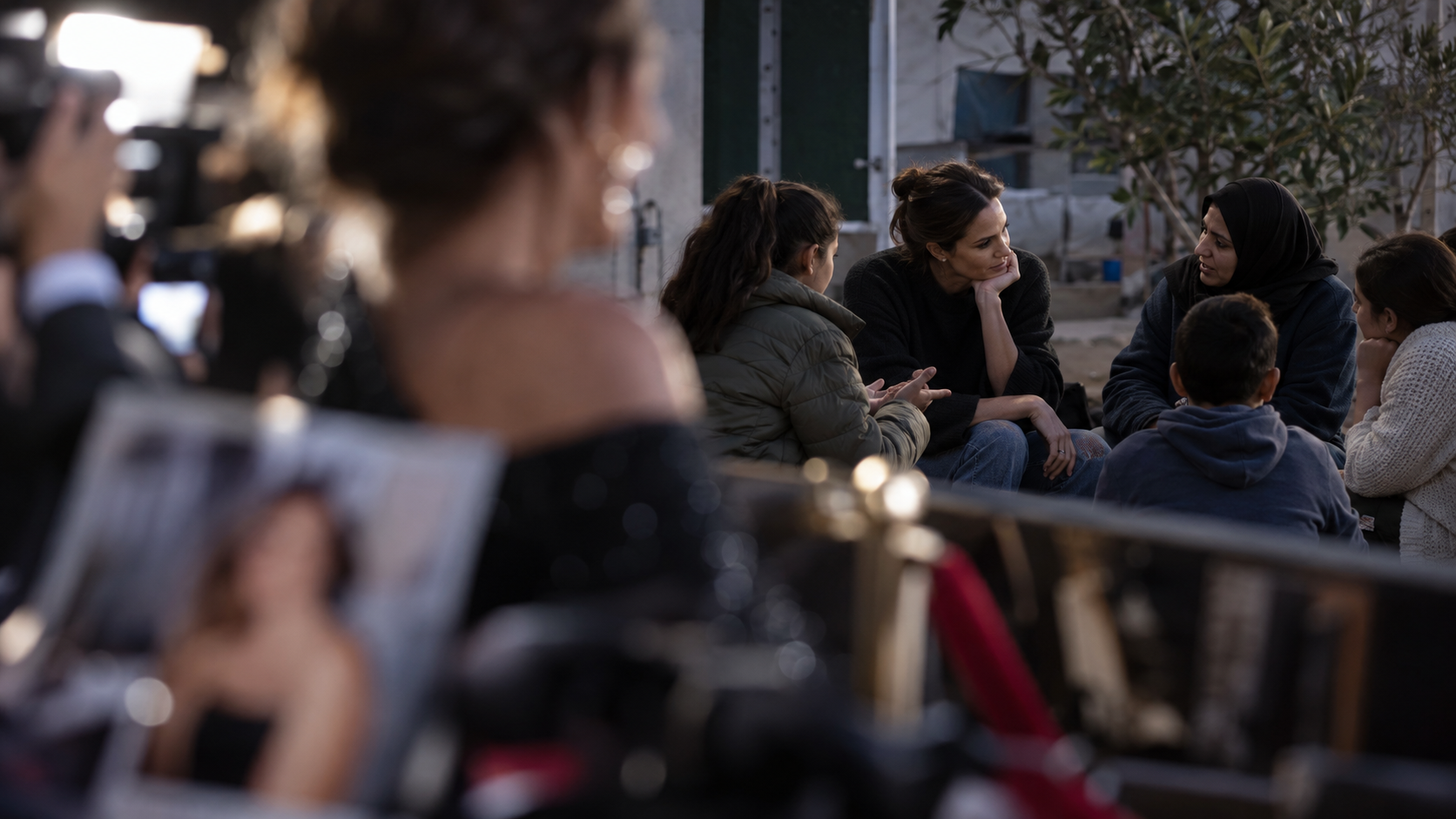
There is a familiar photograph. A famous person has travelled far from the places where we usually see them: a refugee camp, a hospital ward, a field cracked by drought. They are standing or sitting with people whose lives are very different from their own. The cameras are there, and interviews and headlines will follow. It is easy to be cynical about such images, and sometimes we should be.
But a photograph is one moment. Judging someone by it tells us very little about what followed. Motive cannot be read from a face. Conduct over time can be examined. So set motive aside and ask five questions about the years that follow. Did they return? Did they learn? Did they put resources behind it? Did they build something that could continue without them? Did they turn their attention, and the public’s, towards something beyond themselves?
Fame is a spotlight. The attention of millions falls on one person, and usually it stays there. The people described here used some of that attention to illuminate something beyond themselves, and kept doing so long after the first photograph.
Audrey Hepburn answers the first question in the plainest way: she returned. She travelled to Ethiopia in 1988, soon after becoming a UNICEF Goodwill Ambassador. Her tie to the organisation reached back beyond Roman Holiday to a childhood in wartime Europe: she was, she said, among those who received food and medical relief after the Second World War. After Ethiopia she spent weeks giving the press as many as fifteen interviews a day. In the years that followed she saw polio vaccination in Turkey, street children in Ecuador, water projects in Central America and camps for displaced children in Sudan. She testified before the United States Congress, took part in the World Summit for Children and gave speeches promoting children’s rights. In 1992, though ill with cancer, she was still travelling for UNICEF, including to Somalia. She died in January 1993.
Angelina Jolie answers the second and third: she learned first, and then she gave. While filming Lara Croft: Tomb Raider in Cambodia in 2000, she became interested in refugees, and when filming ended she approached UNHCR to learn what she could do. She went on early field missions before becoming a Goodwill Ambassador in 2001. A month after her appointment, she pledged $1 million to UNHCR’s Afghanistan emergency appeal. She served as Goodwill Ambassador until 2012 and as Special Envoy until 2022, carrying out more than sixty field missions over more than twenty years.
Jolie also used her public platform to argue about the causes of displacement, not only its visible consequences. In a 2019 essay for TIME, she argued that the border crisis did not require a choice between security and humanity, and that displacement would continue unless countries addressed the conditions driving people to leave, including war, economic desperation, corruption and climate change. She called for upholding international asylum standards and for working with the countries people were fleeing.
Ted Danson answers the fourth with an organisation. He was living in Santa Monica when he saw a sign at the beach saying the water was polluted and swimming was not allowed. He has said that explaining it to his young daughters was hard. In 1987 he helped establish the American Oceans Campaign, which spent about fifteen years working on ocean protection before becoming part of Oceana. Danson took the cause to Washington. In 2002 he testified before the US Commission on Ocean Policy, urging it to make ocean conservation a cornerstone of federal policy.
There are other versions of the same pattern. Elton John founded his AIDS foundation after his friendship with Ryan White and later took the case for AIDS funding to the US Senate. Yao Ming used his public reach in campaigns against shark fin and ivory. Matt Damon and Gary White built Water.org and later wrote The Worth of Water, while Vanessa Redgrave extended her refugee advocacy into documentary film. Their longer records, alongside those of other public figures whose involvement persisted beyond the first moment of attention, are in the companion piece in Footnotes, Where the Spotlight Went.
None of this answers the harder critique. Ilan Kapoor, a professor at York University in Toronto, argues in Celebrity Humanitarianism that celebrity charity can serve the celebrity’s brand, reinforce the economic system within which fame and wealth are produced, and depoliticise questions of social justice by turning them into problems for managers, experts and famous advocates to solve. The spectacle of visible suffering, he argues, can also draw attention away from less visible structural causes. Jolie is among the figures he examines.
Kapoor’s stated aim is not to judge individual motives, and he does not argue that people in crisis should be left unaided. He grants that celebrity humanitarians often learn the issues, give real time and money and do real fieldwork, and he says as much of Jolie. His argument is that the work can benefit the celebrity economically and symbolically at the same time that it helps others, while leaving larger structures insufficiently challenged. Jolie’s 2019 essay, which argues for addressing the roots of displacement, came six years after his book. It does not dispose of Kapoor’s critique, but it complicates any suggestion that her advocacy remained confined to visible humanitarian symptoms.
Persistence is evidence of commitment and stamina; it is not evidence that the effort is aimed at the right target. Thirty years of returning can be thirty years of tending a system that needed to be changed.
The companion Footnotes piece necessarily follows people who stayed. Those who visited once and went home are less likely to leave enough of a trail to become stories at all, so this cannot tell us how common sustained involvement is. Its claim is narrower: these five questions give us a way of looking at what followed.
Most of us will never be photographed in a refugee camp or called before Congress to speak about a cause. But most of us have encountered something that refused to leave us alone: a place we saw being damaged, a person whose circumstances changed what we understood, a story that kept returning after we had closed it. The first encounter may last only minutes. What matters is what happens after it: whether we return, whether we learn more, and whether anything in our behaviour changes.
CONTINUE INTO THE FOOTNOTES
Where the Spotlight Went
The companion record follows the years, organisations, fieldwork, advocacy and resources that came after the first photograph or public declaration. It also asks a harder question that longevity alone cannot answer: whether the people most affected by the work retained voice and agency within it.
Sources and further reading
- UNICEF, Audrey Hepburn — Goodwill Ambassador from 1988 to 1993Hepburn’s field missions, post-war connection to UNICEF aid, Congressional testimony, public advocacy and final missions in 1992.
- UNHCR, Former Special Envoy Angelina JolieHer Goodwill Ambassador and Special Envoy roles and more than sixty field missions over more than twenty years.
- UNHCR, An Interview with Angelina Jolie (2002)Jolie describes how filming in Cambodia led her to learn more about humanitarian issues and says that she approached UNHCR herself.
- UNHCR, Angelina Jolie responds to UNHCR emergency appeal (27 September 2001)Contemporary UNHCR announcement that Jolie would contribute $1 million to the Afghanistan emergency appeal.
- TIME, Angelina Jolie, The Crisis We Face at the Border Does Not Require Us to Choose Between Security and Humanity (2019)Jolie’s public argument on asylum, migration, international cooperation and structural causes of displacement.
- Oceana, Ted DansonDanson’s account of the polluted-water sign in Santa Monica, the origins of his ocean advocacy and the creation of the American Oceans Campaign in 1987.
- Oceana, Ted Danson Testifies Before U.S. Commission on Ocean Policy (2002)Danson’s testimony urging the commission to make ocean conservation a cornerstone of federal policy.
- Elton John AIDS Foundation, Our HistoryThe foundation’s history and John’s long-term HIV/AIDS advocacy.
- US Senate Committee on Health, Education, Labor and Pensions, Capacity to Care in a World Living with AIDS (2002)The Senate hearing at which Elton John testified on HIV/AIDS.
- WildAid, Yao MingYao’s ambassadorship, shark-fin, ivory and rhino-horn campaigns, and documentary work.
- Water.org, Matt DamonDamon’s route from H2O Africa to Water.org and his longer institutional advocacy.
- Gary White and Matt Damon, The Worth of Water (Portfolio, 2022)Publisher information confirming the book’s authorship and publication.
- UNICEF, Vanessa Redgrave — Goodwill Ambassador since 1995Redgrave’s UNICEF work, field visits and the refugee documentary Sea Sorrow.
- Ilan Kapoor, Celebrity Humanitarianism: The Ideology of Global Charity (Routledge, 2013)The critical framework discussed here: branding, capitalism, depoliticisation, spectacle, structural causes, and the tension between genuine activity and the systems within which celebrity humanitarianism operates.
Image note
The hero image is an illustrative concept image created for The Infinite Why. It is not a documentary photograph of a specific visit or event.